The short answer
Food chaining helps a child try a new food by preparing it to look, feel or taste like a food they already love, then changing one small thing at a time. A study on cricket chips helps show why: a safe, positive first taste in a familiar form can make the next step feel smaller.
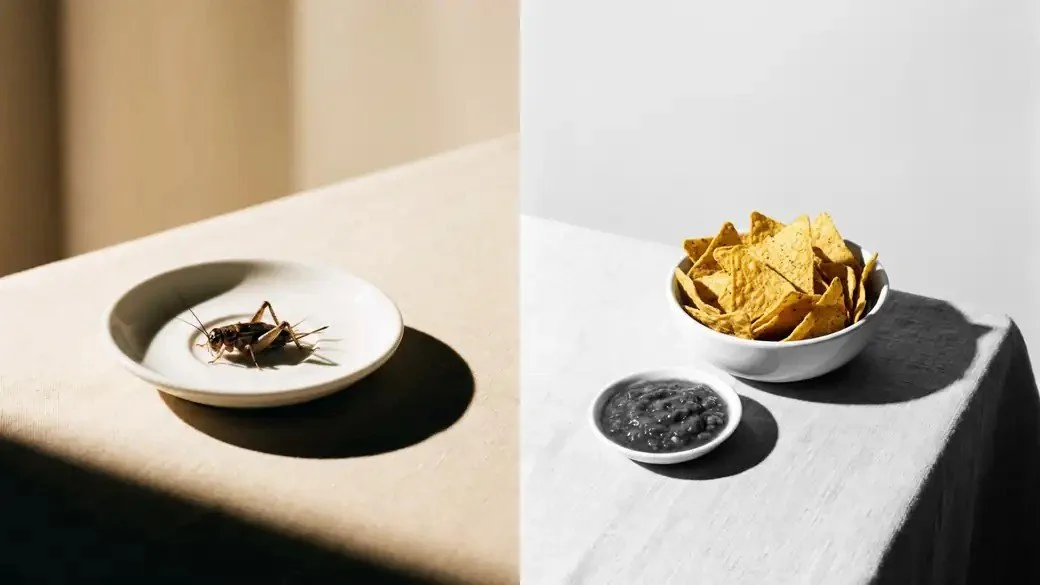
Would you eat a cricket?
Picture a whole cricket on a plate. Legs, antennae, all of it. For a lot of adults, that’s a hard no.
Now picture a bowl of tortilla chips and salsa. The chips are made with cricket flour, and you know it. Would you take one?
Many more people say yes to the chip. That gap between the whole cricket and the cricket chip is a lot like what many children feel when a new food lands on their plate.
What the cricket study found
In 2016, researchers Christina Hartmann and Michael Siegrist ran an experiment with 104 adults in Switzerland (Hartmann & Siegrist, 2016). Each person was randomly placed in one of two groups. One group ate regular tortilla chips. The other ate tortilla chips made with cricket flour.
Nothing was hidden. Both groups were told exactly what was in their chips. Afterward, everyone rated how willing they would be to eat whole, unprocessed insects.
The result: the people who ate the cricket chips were more willing to eat a whole cricket than the people who ate regular chips.
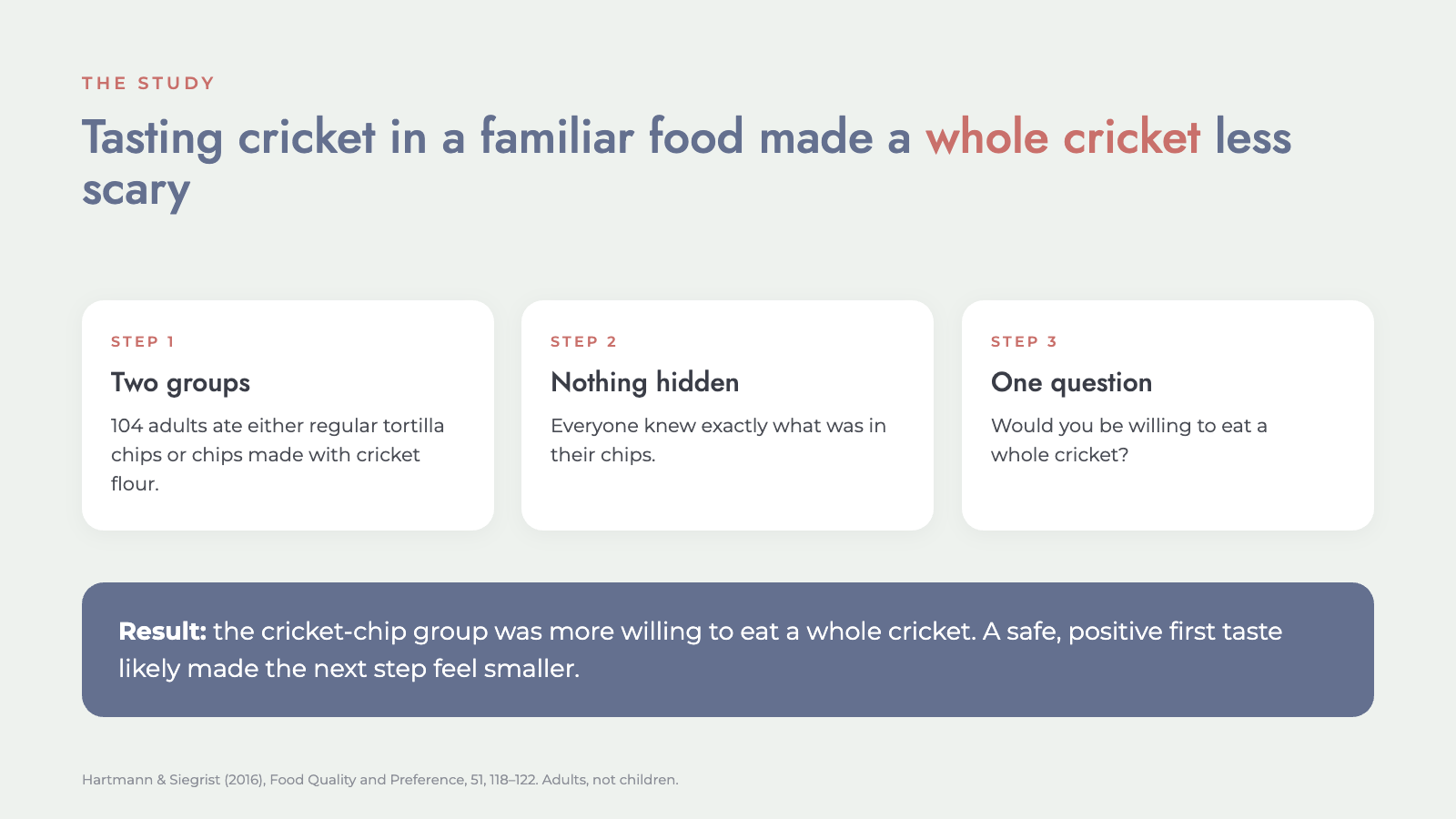
The researchers noticed a few other patterns. People with more food neophobia (fear of new foods) and people who felt more disgust were less willing. People who had eaten insects before were more willing. The authors suggest that one positive experience with a processed insect food can raise willingness, and that repeated experiences may be needed for bigger changes.
A few things to keep in mind
The people in this study were adults, not children. The study also showed that tasting the cricket chips made a difference, but it didn’t test why. One likely explanation is that a safe, positive first taste, in a food that already felt familiar, made the next step feel smaller.
Why this matters for kids
If adults, with years of eating experience behind them, find a new food easier to approach in a familiar form, it makes sense that children do too.
Being cautious about new foods is a normal part of development. Many toddlers and young children go through a stage where unfamiliar foods feel uncertain. For some children, especially those with sensory differences, medical history or past feeding difficulties, that caution is stronger and lasts longer.
For these kids, a plate of plain steamed spinach can feel a lot like that whole cricket. Familiar shapes, colors, textures and flavors help a new food feel safe enough to explore. That’s the idea behind food chaining.
Think about that cricket again. If someone kept pushing the plate closer and saying “just one bite,” would your stomach settle, or tighten? That gut-level reaction doesn’t go away because someone insists. Pressure can actually make it stronger. What helps is a way in that feels safe, like the cricket chip, so your child can get to know the new food on their own terms.
What is food chaining?
Definition
Food chaining
Food chaining supports a child to eat a new food by preparing it in a way that resembles a familiar, preferred food, then changing one small thing at a time.
Fraker et al., 2007
Food chaining was developed by a team of feeding specialists: Cheri Fraker, Mark Fishbein, Sibyl Cox and Laura Walbert (Fraker et al., 2007). Instead of starting with the hardest version of a food, you start with something your child already eats and build a “chain” from there. Each link is only a little different from the one before it.
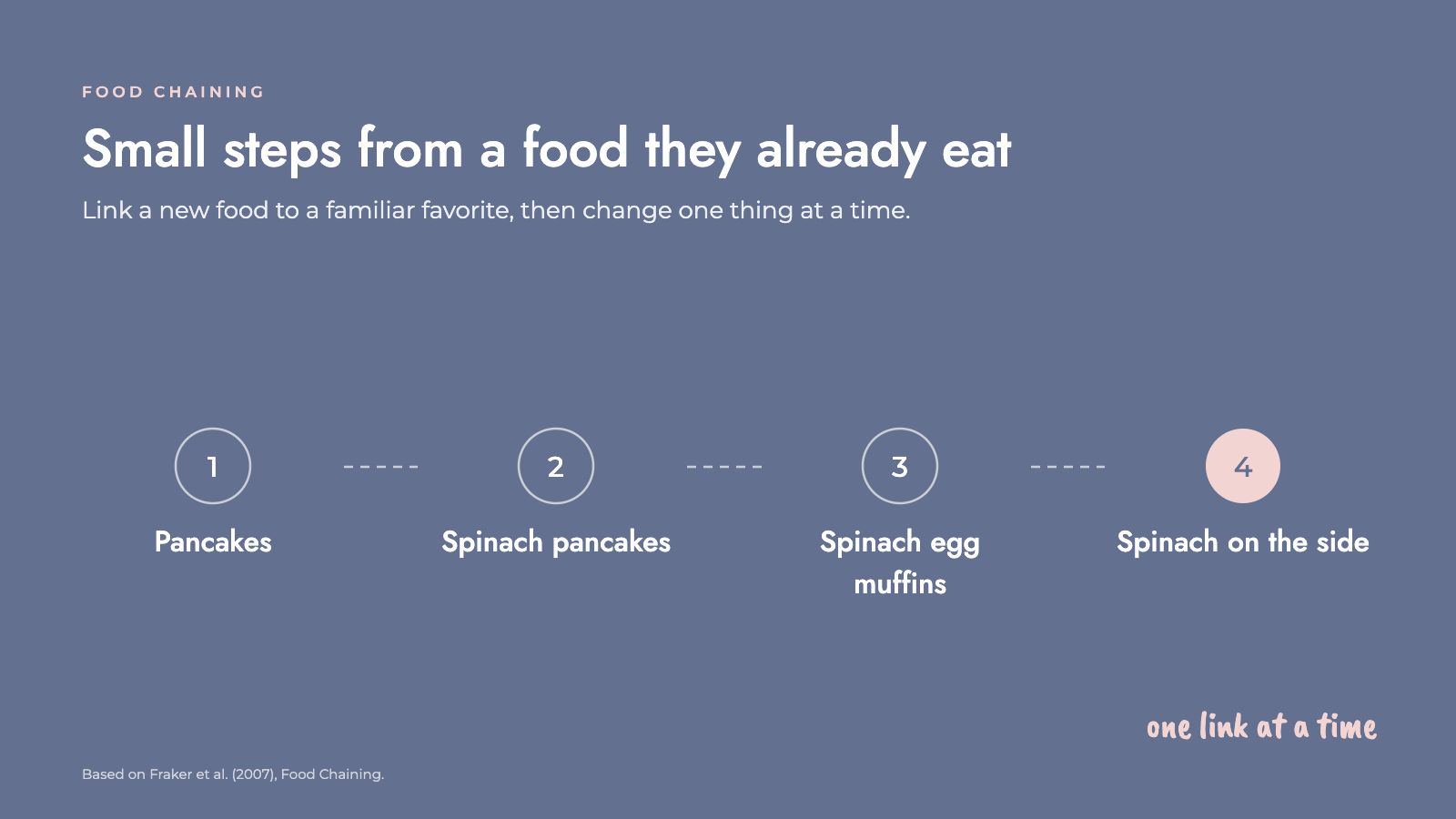
Here’s how that chain might look, one link at a time:
- Start herePancakesA food your child already enjoys and feels safe with.
- One small changeSpinach pancakesSame shape and texture, a new color and a little spinach.
- A new formSpinach egg muffinsStill soft and familiar, with spinach in a different food.
- The goalSpinach on the sideThe new food on its own, next to foods your child enjoys.
Each step changes one thing. Some children move through a chain quickly. Others stay at one link for weeks. Both are okay.
This is not hiding vegetables
It’s tempting to blend spinach into a smoothie and hope no one notices. Hiding vegetables in food can feel like a win, but it doesn’t teach a child anything about the vegetable. They don’t learn what spinach looks like, smells like or feels like, so the next time it shows up on the plate, it’s still a stranger.
Hiding food can also hurt trust. If a child finds out (and they often do), they may start to question foods they used to feel safe with.
Hiding
Spinach is blended in secretly. Your child never sees it, so they learn nothing about it, and may feel tricked later.
Food chaining
Spinach is named, seen and touched. Your child learns about it in a form that already feels safe.
Remember, in the cricket study nothing was hidden. Everyone knew what was in their chips, and tasting them still made a difference. Food chaining works the same way:
- Name it. “These are spinach pancakes. The spinach makes them green.”
- Show it. Let your child see the spinach before it goes in.
- Make it together. Kids can wash, tear, stir or pour.
- Offer it plain, too. A few spinach leaves on the side, with no pressure to eat them.
A familiar food is the bridge. Being honest about what’s inside is what makes it safe to cross.
Try this at home
Start with a food your child already loves. Then think about how a new food could take that same shape. Make the new version together, and keep offering the new food in its natural form too.
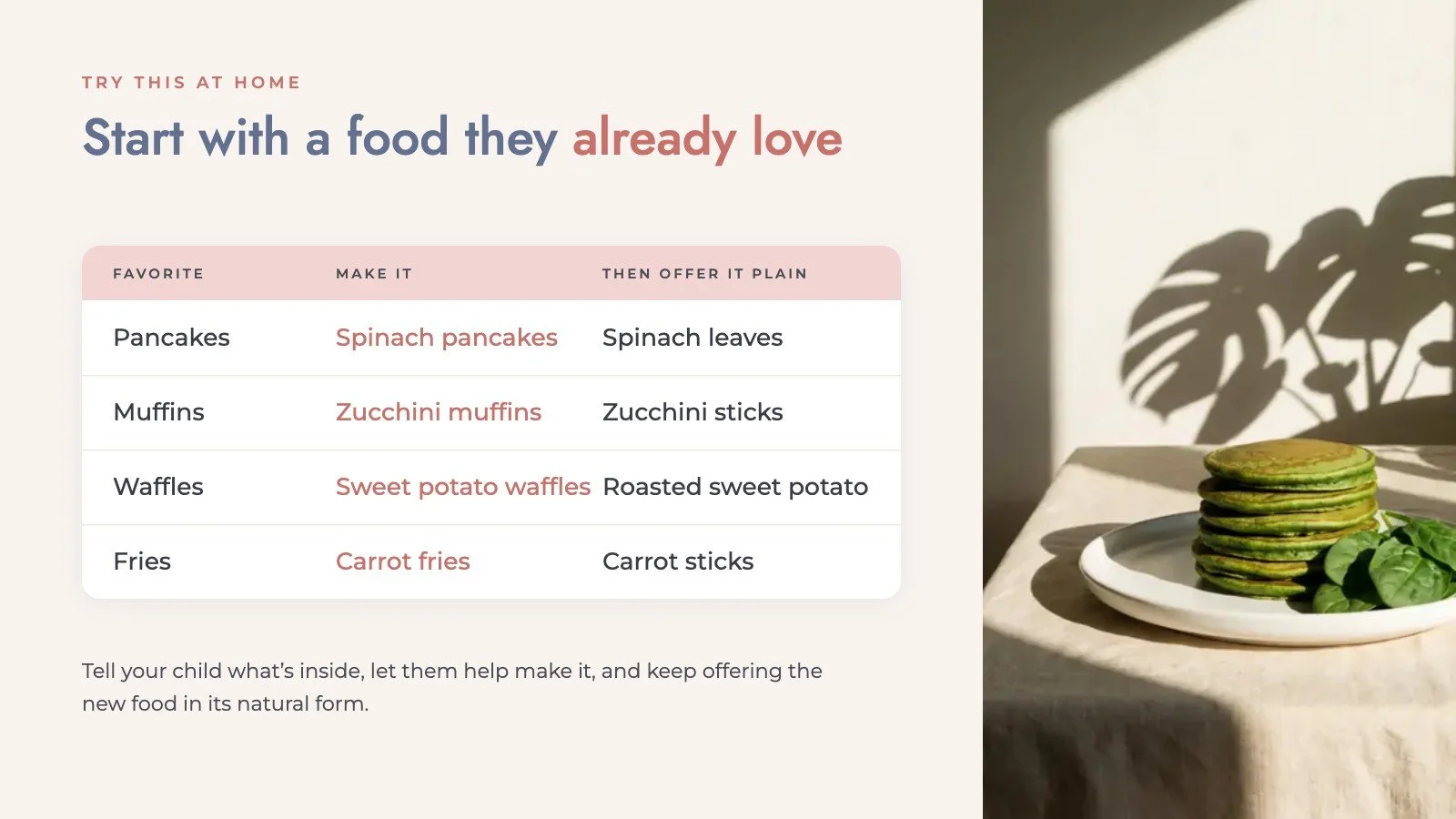
A few things that help a chain go smoothly:
Change one thing at a time
Color, flavor, shape or texture, but not all at once.
Keep a safe food on the plate
Serve a small portion of the new food next to foods your child already eats.
Take the pressure off
Looking, touching, smelling and licking all count. There’s no need to finish it.
Give it time
Many children need 10–15 tries before they accept a new food. A “no thanks” today is still one more try.
When to reach out for support
Food chaining is a gentle place to start, and many families find it helpful at home. But sometimes new foods feel really hard. You might notice:
- Your child’s list of accepted foods is getting shorter
- Meals often end in tears or battles
- Your child gags, vomits or gets very upset around new foods
- You’re worried about growth, weight or nutrition
If any of this sounds familiar, a feeding therapist can help. At Kids Feeding Wellness, I work with children from birth to age 10 and their families, in-home throughout New York and virtually anywhere. Together, we can build a plan that fits your child, one small link at a time.
Book a free 15-minute callFor clinicians: explaining food chaining to families
- Lead with the why. The cricket study is a quick, memorable way to show parents that familiarity lowers the barrier to trying something new, even for adults.
- Be clear about its limits. The participants were adults, it was a single tasting, and it measured willingness rather than eating. Use it as an illustration, and point families to Fraker et al. (2007) for the approach itself.
- Frame chaining as open, not covert. Coach families to name the new ingredient and involve the child in making it.
- Build from the child’s current foods. Start the chain from accepted foods, and pair it with exposure to the target food in its natural form.
- Set expectations. Progress is gradual, and some links take many exposures.
References
Fraker, C., Fishbein, M., Cox, S., & Walbert, L. (2007). Food chaining: The proven 6-step plan to stop picky eating, solve feeding problems, and expand your child’s diet. Marlowe & Company.
Hartmann, C., & Siegrist, M. (2016). Becoming an insectivore: Results of an experiment. Food Quality and Preference, 51, 118–122. https://doi.org/10.1016/j.foodqual.2016.03.003