The short answer
Aim for at least 3 family meals a week. That's where research most consistently sees benefits for children's eating and nutrition. Breakfast, lunch and dinner all count, and you don't need everyone at the table. If you're starting from zero, start with one.
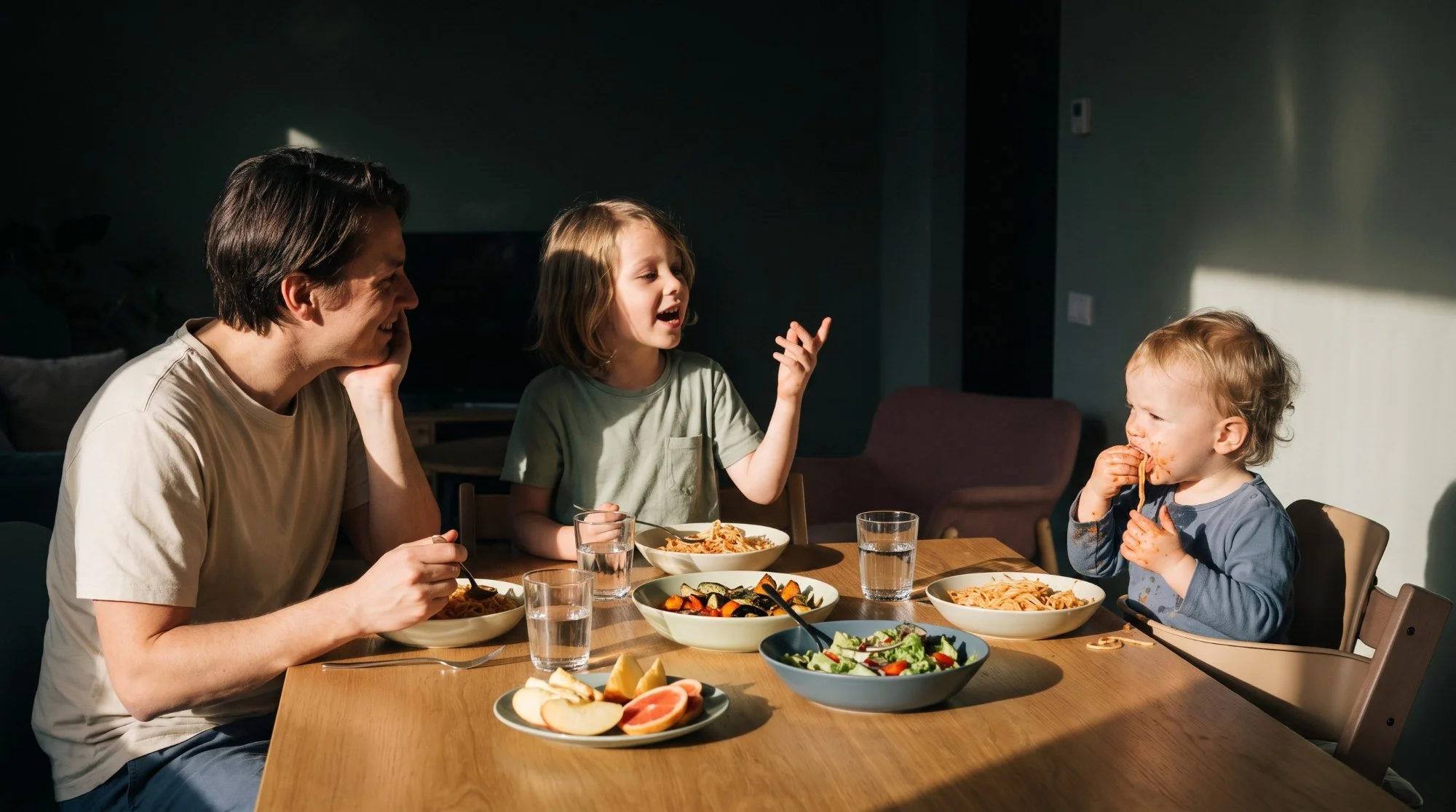
Is the family meal a lost art?
It can feel that way. Between work, school, activities and screens, sitting down together can seem like something from another time.
The research tells a more hopeful story. Researchers in South Australia interviewed parents about family meals in 1993–1994 and again in 2020. The barriers parents described were largely the same in both groups, from busy schedules to the work of getting a meal on the table (Middleton et al., 2023).
So families haven't stopped caring about eating together. Family meals have always taken effort, and most parents could use more support to make them happen. That's what this post is for.
Why family meals matter
Family meals are one of the most studied routines in child feeding, and the findings point in the same direction again and again.
What the research found
A review of 17 studies, including more than 180,000 children and teens, compared kids who shared family meals more often with kids who shared them less often (Hammons & Fiese, 2011).
higher odds of eating healthy foods with 3 or more family meals a week
lower odds of eating less nutritious foods with 3 or more family meals a week
lower odds of disordered eating with 5 or more family meals a week, compared with 1 or fewer
Comparisons for the first two numbers are 3+ meals a week vs. fewer than 3.
A quick note on the research
These studies show links, not proof that family meals cause these results. Families who eat together may be different in other ways too. Still, a larger review of 57 studies found the same pattern in younger and older children and across countries and income levels (Dallacker et al., 2018).
What family meals can support
Nutrition
More fruits, vegetables and key nutrients, and fewer sugary drinks and fried foods.
Trying new foods
Less food fussiness over time, and more chances to see, smell and taste new foods without pressure (Berge et al., 2023).
Connection
A predictable time to talk, listen and be together. Regular family meals are also linked with better emotional well-being in older kids and teens (Brown et al., 2024).
Routine
Predictable meal and snack times help children come to the table hungry and ready to eat. Here's more on how mealtime routines help.
How many family meals a week?
At least 3 a week is the goal most tied to benefits.
- 3 family meals: the goal
- More is a bonus, if it fits your week
Eating together more often, even daily, may add more benefit. But researchers haven't found a perfect number, so think of 3 as a goal, not a test.
What counts as a family meal?
More than you might think. In the research, the benefits held whether the meal was breakfast, lunch or dinner, and whoever in the family was there (Dallacker et al., 2018).
- Breakfast before school
- Saturday lunch
- An early dinner at 5:00
- One parent and the kids
- A simple meal like eggs and toast
Why family meals help picky eaters
For children who are cautious with food, the family table is where a lot of quiet learning happens. In one study, children ages 5 to 9 who ate more family meals showed less food fussiness and better diet quality 18 months later (Berge et al., 2023).
They watch you eat it
Seeing a parent enjoy a food is one of the main ways children learn that it's safe and worth trying.
They see it again and again
Many children need 10–15 tries before they accept a new food. Regular shared meals make all those exposures possible.
They explore without pressure
Looking, smelling, touching and tasting all count. A calm table gives children room to take those steps.
Want more ideas for new foods? Read about food chaining and the 5 Levels of Food Exposure™.
What gets in the way (and what helps)
If family meals feel hard to pull off, you're in good company. These are the barriers parents mention most, with the simplest changes that help.
How the meal feels matters, too
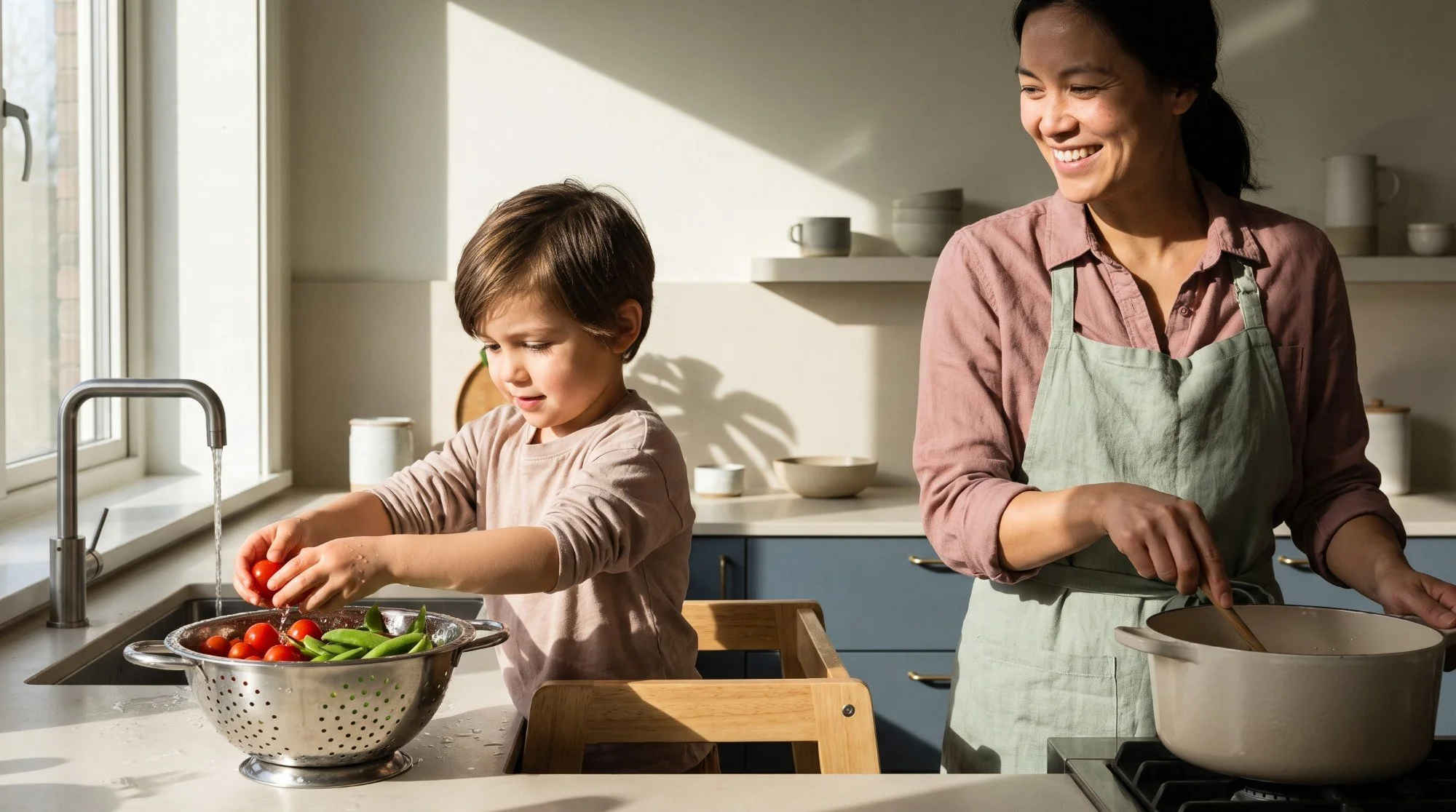
How often you eat together is only part of the picture. A review of 50 studies linked six things with better nutrition for children: the TV off, parents modeling healthy eating, the quality of the food, a positive mood at the table, children helping prepare the meal, and taking a little longer to eat (Dallacker et al., 2019). Here's what that can look like at home.
Screens off
TV off and phones away from the table. It may take a few tries to stick, and it gets easier once it becomes the norm.
Eat the same food together
Sit down and eat with your child, not just serve them. They learn a lot from watching you enjoy your food.
Keep it pleasant
No pressure, praise for eating, or comments about how much anyone eats. Talk about your day instead of the food on the plate.
Invite them in
Let children wash vegetables, stir, set the table or choose a side dish. Kids are often more willing to try a food they helped make.
Linger a little
You don't need a long dinner. A few extra minutes of talking at the table counts. Try one of the conversation starters below.
Your family meal plan: start with one
You don't need to jump from zero to three. Small, specific goals are easier to keep, so here's a simple one-month plan: start with one family meal, practice it for a week, then add one more each week.
Go at your family's pace. If a week feels hard, repeat it before adding more. Slow progress is still progress.
Plan ahead
Pick your family meal days
Your plan
Easy conversation starters
Not sure what to talk about? Keep a few of these handy.
"Your apple is crunchy! What sound does it make?"
"Can you find something red on the table?"
"Who did you play with today?"
"If you were an animal, which one would you be?"
"What was the best part of your day, and the hardest part?"
"What should we make for our next family meal?"
When to reach out for support
Family meals are a helpful routine for every family. But sometimes mealtimes feel hard no matter what you try. It may be time to talk with a feeding specialist if:
- Most meals end in tears, battles or a child leaving the table
- Your child's list of accepted foods is short or getting shorter
- Your child often gags, vomits or gets very upset around food
- You're worried about your child's growth, energy or weight
- Meals regularly take a very long time or end after a few bites
At Kids Feeding Wellness, I support children from birth to age 10 and their families, in-home throughout New York and virtually anywhere. Together, we can make mealtimes feel calmer and more connected.
Book a free 15-minute callReferences8 sources
Berge, J. M., Hazzard, V. M., Trofholz, A., Noser, A. E., Hochgraf, A., & Neumark-Sztainer, D. (2023). Longitudinal associations between family meal quality and quantity: Does one matter more for child, parent, and family health and well-being or are they synergistic? Appetite, 191, Article 107080. https://doi.org/10.1016/j.appet.2023.107080
Brown, C. L., Kay, M. C., & Thompson, L. A. (2024). Eating family meals together at home. JAMA Pediatrics, 178(5), 510. https://doi.org/10.1001/jamapediatrics.2023.6669
Dallacker, M., Hertwig, R., & Mata, J. (2018). The frequency of family meals and nutritional health in children: A meta-analysis. Obesity Reviews, 19(5), 638–653. https://doi.org/10.1111/obr.12659
Dallacker, M., Hertwig, R., & Mata, J. (2019). Quality matters: A meta-analysis on components of healthy family meals. Health Psychology, 38(12), 1137–1149. https://doi.org/10.1037/hea0000801
Fulkerson, J. A., Telke, S., Larson, N. I., Berge, J. M., Sherwood, N. E., & Neumark-Sztainer, D. (2019). A healthful home food environment: Is it possible amidst household chaos and parental stress? Appetite, 142, Article 104391. https://doi.org/10.1016/j.appet.2019.104391
Hammons, A. J., & Fiese, B. H. (2011). Is frequency of shared family meals related to the nutritional health of children and adolescents? Pediatrics, 127(6), e1565–e1574. https://doi.org/10.1542/peds.2010-1440
Middleton, G., Golley, R. K., Patterson, K. A., & Coveney, J. (2023). Barriers and enablers to the family meal across time: A grounded theory study comparing South Australian parents' perspectives. Appetite, 191, Article 107091. https://doi.org/10.1016/j.appet.2023.107091
Vik, F. N., Grasaas, E., Polspoel, M. E. M., Røed, M., Hillesund, E. R., & Øverby, N. C. (2021). Parental phone use during mealtimes with toddlers and the associations with feeding practices and shared family meals: A cross-sectional study. BMC Public Health, 21, Article 756. https://doi.org/10.1186/s12889-021-10757-1