When to Start Solids: Signs of Developmental Readiness & Why 6 Months Is the Sweet Spot

One of the most common questions parents ask is:
“When should I start feeding my baby solid food?”
You’ll hear different answers—some say 4 months, others say 6—and it can feel confusing.
When we look at recommendations from the World Health Organization, American Academy of Pediatrics, and Centers for Disease Control and Prevention, most point to around 6 months as the ideal time for the introduction to solids.
But here’s the part that often gets missed:
It’s not just about age—it’s about developmental readiness.
Most babies are ready for the transition to solids around 6 months, when their body, skills, and interest in food begin to align.
Why 6 Months Is Often the Right Time for the Introduction to Solids
Around this age, several key systems come together to support a smoother and safer transition to solids.
Your baby’s digestive system is more mature, allowing them to better tolerate a wider range of foods. Their immune system is also stronger, helping them handle new exposures outside of breast milk or formula. At the same time, their nutritional needs begin to shift—especially for nutrients like iron and zinc that are essential for brain development, growth, and overall health.
Just as importantly, your baby is developing the coordination needed for eating. Certain motor milestones play a critical role in supporting safe and efficient feeding, allowing babies to better manage, manipulate, and move food within their mouth.
These internal changes, combined with developing oral motor and postural control, create a strong foundation for beginning solids in a way that supports both safety and long-term feeding success.
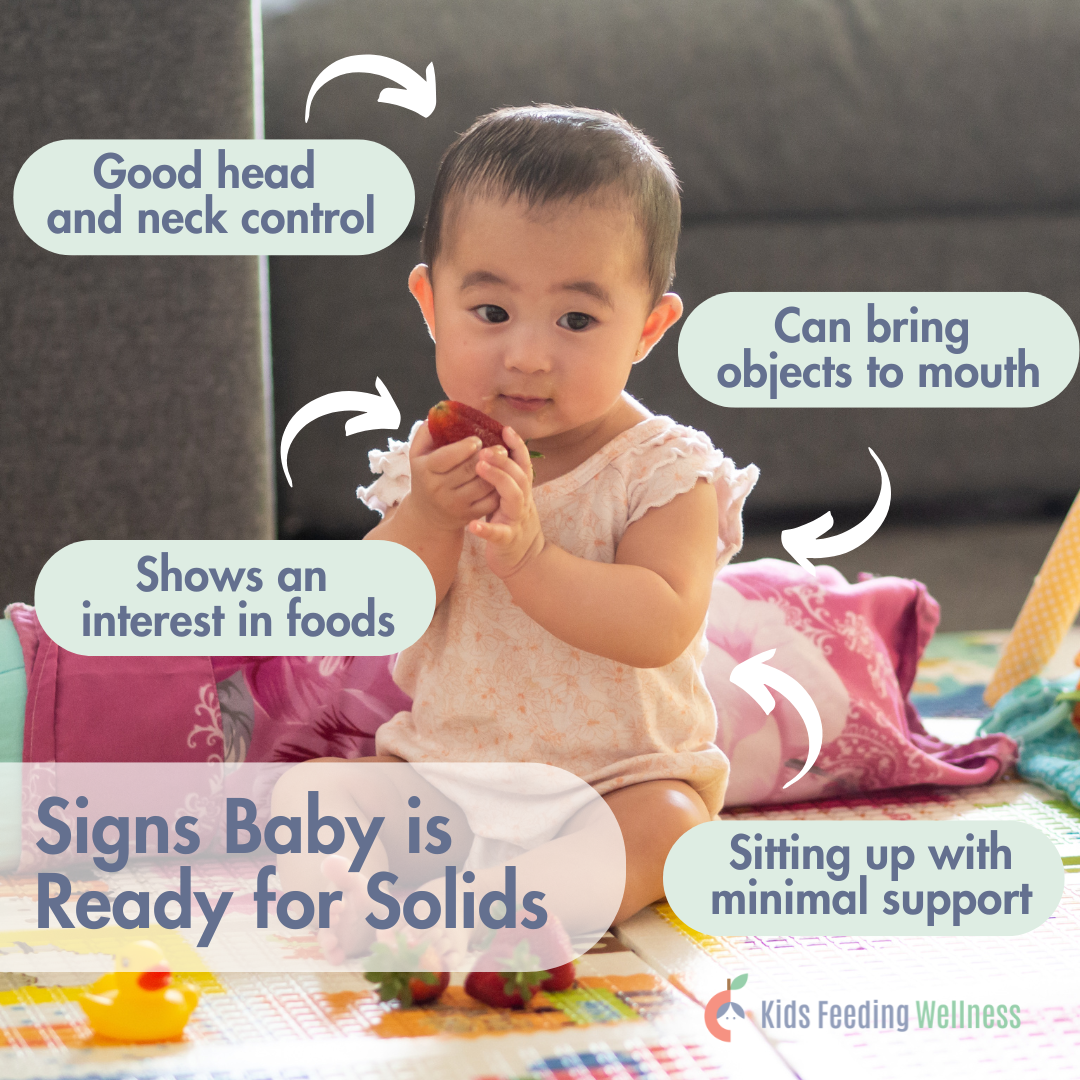
Signs of Developmental Readiness for Solids
While age provides a helpful guideline, developmental readiness is what truly determines whether your baby is ready for the introduction to solids.
Look for these signs:
Sitting with support, showing improved trunk stability
Strong head and neck control, which supports safe chewing and swallowing
Bringing objects to their mouth, an early form of self-feeding practice and oral exploration
Showing interest in food, such as watching, reaching, or opening their mouth
When these skills begin to come together, your baby is not only showing interest but also demonstrating the physical ability to safely begin the transition to solids.
A Quick Note on Tongue Thrust
You may notice your baby pushing food out with their tongue when first starting solids.
This is completely normal.
The tongue thrust reflex is protective (it helps prevent choking) and it doesn’t disappear overnight. In fact, practice with new textures is what helps integrate this reflex over time, not waiting for it to fully go away.
The Role of Milk During the Transition to Solids
During the introduction to solids, breast milk or formula should remain your baby’s primary source of nutrition until around 12 months.
Solids are not meant to replace milk right away.
Instead, this stage is about:
experiencing new textures
exploring flavors
building oral motor skills
learning how to eat
Think of this phase as practice, not pressure to start replacing milk right away.
When Your Baby Might Need More Time
Every baby develops at their own pace.
While around 6 months is often recommended for starting solids, it’s important to remember every baby is unique. If your little one was born prematurely, has faced feeding challenges, or shows sensory sensitivities, you might need to wait a bit longer (Wright et al., 2011). The most important thing is looking for signs of readiness, rather than just the calendar.
A Gentle Way to Support the Transition Before 6 Months
While full solids are typically introduced around 6 months, there is a meaningful way to begin supporting your baby’s skills earlier.
Natural food teethers (resistive foods like raw carrots, watermelon rind, and chicken bones) can be offered as early as 4 months (when developmentally appropriate and supervised).
These early experiences help babies:
explore texture safely
experience the varying flavors of real food
build jaw strength
practice chewing patterns
become more comfortable with food
This can make the eventual transition to solids feel more familiar, confident, and less overwhelming.
Click here if you’d like to learn more.
The Bottom Line
6 months is often the sweet spot for the introduction to solids because your baby’s body, brain, and developmental skills are more aligned for success.
But more than anything:
Focus on developmental readiness, not just age.
Because when your baby is ready—and you have the right tools to support them— that’s when the transition to solids becomes a positive and meaningful experience.
References
American Academy of Pediatrics. (2022). Starting solid foods. HealthyChildren.org. https://www.healthychildren.org/English/ages-stages/baby/feeding-nutrition/Pages/Starting-Solid-Foods.aspx
American Academy of Pediatrics. (2024). Policy update on nutrition and complementary feeding guidelines.
Centers for Disease Control and Prevention. (2025). When, what, and how to introduce solid foods. https://www.cdc.gov/infant-toddler-nutrition/foods-and-drinks/when-what-and-how-to-introduce-solid-foods.html
Chiang, K. V., Hamner, H. C., Li, R., & Perrine, C. G. (2023). Timing of introduction of complementary foods — United States, 2016–2018. MMWR, 69(53), 1969–1973.
Noles, D. L., Matzeller, K. L., Frank, D. N., Krebs, N. F., & Tang, M. (2025). Complementary feeding and infant gut microbiota: A narrative review. Nutrients, 17(5), 743.
Wright, Charlotte M., Kirsty Cameron, Maria Tsiaka, and Kathryn N. Parkinson. "Is baby‐led weaning feasible? When do babies first reach out for and eat finger foods?." Maternal & child nutrition 7, no. 1 (2011): 27-33.
World Health Organization. (2023). Complementary feeding of infants and young children 6–23 months. https://www.who.int/publications/i/item/9789240081864